It is just running.
5:00am I set two alarms for waking up. I have been through many situations where one alarm clock is either defective or not loud enough. I have already set out my running gear the night before, in order of how I will get dressed. Shoes on bottom, then socks, then shorts, then heart rate monitor, then bandaids (to avoid the dreaded “nipple chafing”), then Body Glide, then running top (which already has my race number attached with safety pins).
This is the start of the day. Don’t mistake my recounting as though I am setting off to save the world. It is a running race. Nothing more. But also nothing less. This is how it all starts, though. I know this morning will start out cool and rainy. I know I’ll have trouble finding parking. I know that, 1 ½ hours into the race, I’ll be feeling tired and, over the next 2 hours, I’ll entertain thoughts of quitting or walking, or stopping. My legs are going to hurt, a lot. They already feel that way.
5:30am I am dressed. I heat up some oatmeal, eat some yogurt, and put a slice of bread in the toaster. When it is all said and done, I finish eating around 5:45.
I think the endurance race, be it a marathon, ultramarathon, Ironman, or some other extreme endurance event, is a test of our inner courage, sublimity, humility, pain threshold (or lack thereof), and character. It is sometimes difficult to explain to someone not associated with this life why it is important to us to do this. I spoke with someone after the race who was a spectator who said that, after cheering and watching all the runners, she wanted to be out there too, running, and hearing the cheers for her. I don’t think of this as self-absorbed thinking. I think this is really a part of how we long to feel heroic. If watching a race inspires one to want to get on track again and get moving, then we’re all better as a result of that.
6:00am I get into my car and head out for the race. I speak with my Mom and Dad before I go, knowing they’ll be up, and they wish me good luck. My Mom says if it isn’t raining she’ll be out at Mile 21 to cheer me on.
Find the one thing you were meant to do. “Follow your bliss”, says Joseph Campbell. It’s easier said than done sometimes, but something as “simple” as a marathon, with its natural grand nature, inspires and humbles us. I was meant to run a marathon, or two, or, in this case, my twelfth. I tell myself this as I am driving, with my “Killers” CD playing. I started off the morning with Enya to relax me, but now I need something to wake my brain up.
6:20am I park the car at 6th and Cambie. I have decided to jog to the race first so that I have a chance to warm up. It’s lightly raining.
Ultra-endurance events show us something we didn’t know about ourselves. I wonder, at this moment, what I am being shown. When I ran my first marathon, I remember feeling that I could accomplish anything I set my mind to. When I ran Boston, I realized I not only had desire, but some talent as well. When I ran Ironman in 2002, I realized that I had the best friends and family all around me, without whom none of this would ever have been realized. What lesson will I take from this race?
6:35am I arrive at the race site. I’ve decided not to go up to the Terry Fox Statue with the hoards of runners all making each other nervous. It would be nice to say “hi” to the 100’s of people I may know there, but I just want to relax. I’ve decided to hang out at the North Shore Athletics tent with a few of the training friends I know there. I can leave my bag there, get warmed up, and have a cup of coffee before the race.
After Ironman in 2002, I was lost. I felt like Frodo or Bilbo Baggins at the end of The Lord of The Rings. I couldn’t go back. I couldn’t go back to the person that I was before, anticipating something new in a marathon, or the Ironman. I had decided to take a year off of marathons and training. I thought I needed a mental break. I looked at the training and racing as being somewhat trivial. I needed something more. So I looked at school, a new job, new roommates, new relationships, everything new. I expected some great epiphany after Ironman. It didn’t seem to be coming.
7:00am Time for a short jog to loosen the legs again. I go out with Paul Purin, the Clinic Instructor at NSA, and we jog around the block with the rest of the marathoners.
We shouldn’t make the Ironman, or a marathon, out to be more than it is. But we shouldn’t diminish its value either and make it less than what it is. Many think of us runners and triathletes as self-indulgent and ego-obsessed A-type personalities. I do believe we see in others what we fear about the world. Personally, I see most athletes in the light that we have found “one thing” that makes us come alive in all the ways I speak of above. Me? I was going about life, minding my own business, when one day a friend of mine decided he would run a marathon. That was 1997. I was impressed by the challenge the marathon presented. I was then impressed by the challenge the Ironman presented in 2001, and decided to sign up for 2002, without having a road bike, or an ability to swim more than 400 meters. I was ill-equipped for the road ahead.
But I am always nervous about a race. There is a big part of me that doesn’t want to be here. A big part that says it would be WAY nicer to stay in bed, to sleep in until noon, to eat some pancakes, and look out into the cold, rainy Sunday with gleeful comfort that I don’t have to be out there. I could forego all the pain, self-doubt, surefire disappointment and the long, arduous, path of 42.2 km that will, in the end, just take me back to where I started anyway. What a foolish idea this was!
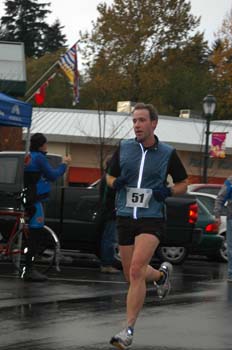
7:29am I am at the starting line with 4000 other runners. My training partner, Walter, is beside me, and we’ve decided on 7:30/mile pace to start. Steve King, the “Voice of Ironman” is announcing the race, which is always special. I love being at races where he is announcing. He adds a knowledge, a sense of humour, and an unmistakable voice to the race that just lets you know that you’re about to start something special.
7:30am We’re off.
I’m back! I’m an average guy swept up in a reluctant journey. And now I’m doing this for the 12th time.
Mile 1-3 Time: 22min31 seconds. Average Heart Rate 165.
We’re off to the start we planned. It’s a 7:30 pace roughly. The first 2 miles, I am certain, are a little slower. I feel pretty good. My legs are fresher than I thought they would feel, and the pace is comfortable.
Mile 4 I run the next mile in 7 minutes, 10 seconds. I was hoping to increase the pace to 7min15sec/mile, but I’ve gone a little quicker. Walter has held back. Somehow I think that was the smart move. My average heart rate for the mile is 177. Too high.
Mile 5 It is mostly flat or a slight downhill, and I notice immediately as I come through with a 6 min 56 mile. Keep in mind, I need a 7:15 mile average to make a 3:10, and a 7:30 mile to be lower than 3:20. I’m still too fast, and my average heart rate is 177 again.
Mile 6 I’ve slowed down the pace a litte. I’m at 7:10/mile. This is a little better, and I come through the 10km mark around 44 minutes.
Mile 7 A 7:03 mile has me a little cocky now. I believe I can hold this pace and I’ve decided I’m going to try. I’ve started running now with a fellow Ironcops for Cancer team member from Edmonton, and we’re chatting about the Ironman, which helps the time go by.
Mile 8 I push through at a 7:01 mile. By now we’re over the Georgia viaduct and heading into East Vancouver. Again, I feel pretty good, and I decide to try to hold the pace for a bit. My heart rate is around 176 now, but it doesn’t feel uncomfortable. But I should listen to my heart rate, as it’s telling me that my good feeling is in my head, as I know a 178 heart rate is not sustainable.
Mile 9-11 I push through the next 3 miles in 21:13. Again, it’s a flatter section, and I’m looking at hitting my time of 1:35 with a little to spare. Good work! Except that my heart rate is still hovering at 179.
Mile 12 A 7:10/mile here. I decided to try to get my heart rate under control a little, and I start to breath a little more fully. My heart rate at the end of the mile averages at 176. A slight improvement. My overall time, at this point, is 1:26:17.
Mile 13 A 7:16/mile. This is about the pace I wanted, and it also signifies the entry into Stanley Park. I do feel as though I have slowed slightly but there are also a few little inclines that have started to take their toll. My average heart rate for this mile is around 180, and that’s concerning. Looking at my watch now as I retell this, my AVERAGE heart rate for the first 13 miles was around 178.
I go through the ½ mark in about 1:34:40. That’s about where I wanted to be, and I feel a little tired but not enough to stop me.
Mile 14, I don’t have a split on this but I did hit it at 1:40:56. My heart rate from the halfway mark was 179. We are about to start the hill up Pipeline Road, a deceptively tough hill.
Mile 15. I can feel things starting to go. My groin on my left side started twinging about 4 miles back, and I have felt it get stronger and stronger. Now it seems to have leveled off in it’s discomfort, so I figure as long as I can stick with this pace I’ll be fine. At the end of this mile, though, my time is 7:25. But my heart rate is 169. I’m slowing down.
Mile 16. 7:31. I have a sneaking feeling this will have to be the standard for the rest of the race. I can’t see myself getting back to the 7minute mile and I am running hard again – average heart rate is 179 for this mile.
Mile 17-18. I come through in 15:01, which is perfect considering part of this section is the Burrard Street Bridge. That’s a tough stretch, and holding my pace is something I am happy about. My average heart rate, too, is lower, at 173. The problem, though, is that I am starting to really feel my left leg tiring.
Mile 19. I am holding steady. I run this one at 7:33 and my heart rate is 175. I have managed to pick up a couple of spectators who start running with me (Sasha and Lisa). It’s always nice to get to run with a couple of cute girls for a while, and it definitely helps as I feel better now (they are awesome runners anyway and very upbeat).
Mile 20. I hit this one at 7:46. I knew I was starting to slow down but I now don’t feel as though I can get going any faster. My heart rate is 171. I’m not pushing aerobically as much, but I can’t get my legs moving any quicker and I am sore.
Mile 21. 7:55… The train is starting to derail. I can feel a lot of pain in my legs. One thing that keeps me going is my Mom at the top of the hill on 4th Avenue. Had she not been there I really felt like I could have started walking. But you can’t do that when mom’s watching J. Average heart rate is 171.
Mile 22. Pain becomes an unfriendly companion. I am pushing through it, but I feel that the battle is being lost. I want to slow down, and my pace drops to 8:13/mile. My heart rate is 171. The effort just isn’t there. I don’t know if I can summon it up.
Mile 23. 8:35. Ouch. That is a rude awakening. That, and the fact that my friend, Jerry, has an aid station set up outside his place at the 24 mile marker. I told him if I was on pace to qualify for Boston, I’d be passing by his aid station by now. At this point, I am one mile behind. My heart rate has dropped to 160 for the mile. It’s all leg pain now.
Mile 24-25. I won’t be finished yet. Do I have it in me for 3 more miles? Yes. I can get there. I stop the hemorrhaging and manage a 17:21, which includes the 2nd pass over the Burrard Street Bridge. It’s an 8 min 40 sec average. My heart rate is 166. I pass by Jerry’s station and he and Cassandra (his partner) are there. Cassandra cheers me on, and Jerry does too, but also says “you’re 8 minutes late!” Strange enough, that’s encouraging and motivating. It makes me laugh a little, like I am late for the party. Who needs a clichéd “you’re almost there”? I like it. It’s something to file for the next race. I won’t be 8 minutes late next time. I’ll be early…
Mile 26 (.2). As I come down the final mile, I bring my legs up and start to try to regain some form. I have achieved what I set out to do. I’ve run a marathon after a bike ride, and I’ve run a sub-3:20, which is what I planned to do, and what I had hoped to do. This leg of the journey is complete. I’ve passed my first test. It’s time to recover, have a nap, and start planning for the next test… Victoria ½ Ironman. And I have six weeks until that one."I can't believe that God put us on this earth to be ordinary." Lou Holtz